Skip to content
Sora Lifesciences
Consulting

Strategy Consulting

Reduce uncertainty and make informed decisions by combining market intelligence, primary research, competitive analysis, and 30+ years of MedTech expertise.

Strategists reviewing market-scenario forecasts on a boardroom dashboard
01 / 08

Future Market Landscape

Anticipate where your market is headed before making critical business decisions, combining market intelligence, stakeholder insights, and strategic analysis to forecast market evolution and identify emerging growth opportunities.

An analyst reviewing a forward-looking market forecast

Key assessments include:

01The External Environment

How will the healthcare ecosystem evolve?

  • Regulatory and policy changes
  • Reimbursement evolution
  • Government healthcare initiatives
  • Demographic and epidemiological trends
  • Healthcare infrastructure expansion
  • Macroeconomic and funding trends
  • Clinical guideline evolution
02The Customer

How will customer needs and purchasing decisions change?

  • Emerging unmet needs
  • Changing clinical practice patterns
  • Premium vs value purchasing
  • Adoption drivers and barriers
  • Procurement behaviour
  • Patient expectations
  • Care pathway evolution
03The Competition

How will the competitive environment change?

  • Emerging technologies
  • Pipeline products
  • New market entrants
  • Competitive positioning
  • M&A and partnerships
  • AI and digital health disruption
  • Innovation trends
Key question we answer

How will the market evolve, and what will it look like in the future?

02 / 08

Future Technology & Innovation Landscape

Identify emerging technologies, evaluate their commercial potential, and understand how innovation is likely to transform the market over the coming years.
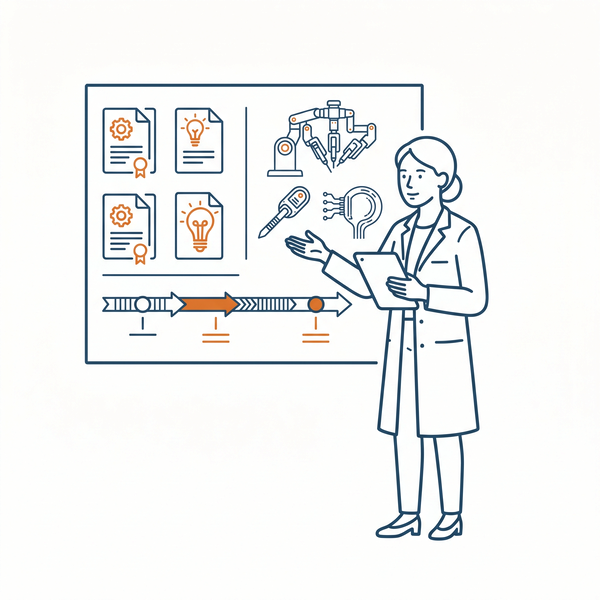
A researcher reviewing an emerging-technology pipeline

Key assessments include:

01

Innovation Retrospective

What has worked — and what hasn't?

  • Technology graveyard analysis
  • Failed commercialization attempts
  • Clinical and commercial barriers
  • Lessons learned from previous innovations
02

Technology Evolution & Innovation Landscape

What is shaping the future?

Monitor emerging technologies and identify the organizations driving the next wave of innovation — next-generation products, platform innovations, digital health and AI integration, robotics and automation, and new materials and manufacturing innovations.

  • Emerging technologies and platform innovations
  • Innovation pipeline
  • Startup and investment activity
  • Patent landscape
  • Academic research
  • Strategic partnerships and collaborations
  • Competitive innovation benchmarking
03Our differentiator

Clinical & Commercial Validation

Will the market actually adopt them?

Our primary research capabilities let us validate future technologies directly with physicians, healthcare providers, payers, and other key stakeholders — so you can assess which technologies are most likely to succeed commercially.

  • Physician interest and adoption potential
  • Clinical unmet need
  • Value proposition testing
  • Adoption drivers and barriers
  • Willingness to switch
  • Expected impact on clinical workflows
  • Perceived differentiation
  • Commercial attractiveness
Key question we answer

Which emerging technologies will shape the future—and which are most likely to succeed?

03 / 08

White Space Opportunity Assessment

Uncover gaps in the market, evaluate their commercial potential, and prioritize opportunities that align with your capabilities and long-term growth strategy.

An analyst mapping unmet needs and market gaps

Key assessments include:

  1. 01STEP

    Market Gap Assessment

    Where are the unmet needs?

    Evaluate gaps across the healthcare ecosystem to identify areas where existing solutions fail to fully address customer needs.

    • Unmet clinical and customer needs
    • Current treatment or workflow limitations
    • Underserved patient or customer segments
    • Geographic gaps
    • Care pathway bottlenecks
    • Customer pain points
  2. 02STEP

    Competitive & Technology White Space

    Where is competition limited or absent?

    Assess the competitive landscape to identify underserved market segments and opportunities with limited competitive intensity.

    • Competitive saturation
    • Product positioning gaps
    • Portfolio gaps
    • Emerging market segments
    • Technology whitespace
    • Areas with limited innovation
  3. 03STEP

    Opportunity Prioritization & Validation

    Which opportunities are worth pursuing?

    Validate and prioritize identified opportunities based on market attractiveness, customer demand, and strategic fit.

    • Commercial potential
    • Market size and growth
    • Customer willingness to adopt
    • Strategic fit with existing portfolio
    • Feasibility and implementation considerations
    • Risk vs. reward assessment

    Outcome: high-potential white space opportunities for innovation, portfolio expansion, market entry, and long-term growth.

Key question we answer

Where are the unmet needs and underserved opportunities that competitors are not addressing?

04 / 08

Commercial & Strategic Due Diligence (M&A)

Acquiring a healthcare company requires more than evaluating financial performance. Understanding the commercial viability, competitive position, customer adoption, and future growth potential of a target is equally critical. Our commercial and strategic due diligence helps investors and acquirers validate investment assumptions, identify key risks, and uncover value-creation opportunities before capital is deployed.

A boardroom commercial due-diligence review

Key assessments include:

  1. 01PILLAR

    Market Quality & Future Outlook

    Is this a market worth owning for the next 5–10 years?

    The target may be performing well today, but investors want to know whether the market itself will continue to grow.

    • Market size and forecast
    • Growth drivers
    • Clinical practice evolution
    • Technology trends
    • Competitive intensity
    • Regulatory changes
    • Reimbursement outlook
    • Potential disruptors

    This determines whether future growth is being driven by the company — or simply by a growing market.

  2. 02PILLAR

    Commercial Position of the Target

    How strong is the company's competitive position?

    Rather than asking whether customers will adopt the product, we assess why customers are buying today — and whether that advantage is sustainable.

    • Market share
    • Brand perception
    • Clinical reputation
    • Customer loyalty
    • Competitive differentiation
    • Pricing power
    • KOL support
    • Installed base
    • Product portfolio depth

    This tells the buyer whether the company has a durable moat.

  3. 03PILLAR

    Customer & Channel Validation

    Our differentiator

    Can we trust management's story?

    Verify the story behind the numbers. Beyond financial performance, we independently validate management's commercial claims by engaging directly with customers, physicians, distributors, and industry stakeholders to assess customer loyalty, competitive differentiation, channel strength, and market perception.

    • Customer satisfaction
    • Reasons for purchase
    • Switching behaviour
    • Renewal rates
    • Competitive threats
    • Distributor commitment
    • Channel effectiveness
    • KOL perception

    The objective is to identify hidden commercial risks that aren't visible in sales data — where Sora's primary research access is a decisive differentiator.

  4. 04PILLAR

    Growth Potential

    Where can this business grow next?

    This estimates the headroom remaining after acquisition.

    • Geographic expansion
    • New indications
    • Adjacent customer segments
    • Product extensions
    • Portfolio expansion
    • Cross-selling opportunities
    • Pricing optimization
    • Market penetration opportunities
  5. 05PILLAR

    Strategic Fit & Synergies

    Does this strengthen the buyer?

    • Portfolio complementarity
    • Technology fit
    • Manufacturing synergies
    • Commercial synergies
    • Customer overlap
    • Distribution synergies
    • Pipeline fit
    • Integration complexity
Key question we answer

Can this business create sustainable commercial value after acquisition?

05 / 08

Adjacent Opportunity Mapping

Sustainable growth doesn't always require entirely new products. We help healthcare organizations identify adjacent markets, clinical applications, customer segments, and technology opportunities where existing capabilities can be leveraged to accelerate growth while minimizing development risk.

Mapping an existing capability into adjacent markets

Key assessments include:

  1. 01STEP

    Existing Asset Assessment

    What strengths can be leveraged?

    We begin by developing a comprehensive understanding of the current product, technology, or portfolio to identify its transferable capabilities.

    • Core technology capabilities
    • Current indications and use cases
    • Clinical value proposition
    • Product limitations
    • Competitive strengths
    • Existing customer base
  2. 02STEP

    Adjacency Opportunity Mapping

    Where else can this capability create value?

    We systematically identify opportunities beyond the current market.

    • New disease indications
    • New procedures
    • New patient populations
    • New physician specialties
    • Adjacent care pathways
    • New healthcare settings
    • Geographic expansion opportunities
  3. 03STEP

    Innovation & Capability Extension

    How can existing technologies evolve?

    Evaluate how incremental innovation can unlock new commercial opportunities.

    • AI-enabled applications
    • Software integration
    • Digital health capabilities
    • Workflow optimization
    • Product enhancements
    • Accessory development
    • Platform extensions
    • Combination solutions
  4. 04STEP

    Commercial Feasibility Assessment

    Which opportunities are worth pursuing?

    Each adjacent opportunity is evaluated across key commercial dimensions.

    • Market attractiveness
    • Customer demand
    • Competitive intensity
    • Clinical adoption potential
    • Regulatory complexity
    • Development effort
    • Revenue potential
    • Strategic fit
  5. 05STEP

    Opportunity Prioritization & Growth Roadmap

    Where should you invest first?

    We prioritize opportunities using a structured evaluation framework.

    • Market size
    • Time to market
    • Investment required
    • Strategic alignment
    • Technical feasibility
    • Commercial potential
    • Competitive advantage
    • Risk profile
Key question we answer

Where else can our existing technology, product, or capabilities create growth?

06 / 08

Market Prioritization

A highly specialized offering used to objectively evaluate and prioritize your target countries for product commercialization. Market size alone does not dictate the sequence of market entry — ease of entry, regulatory barriers, market acceptance, the reimbursement landscape, and willingness to pay collectively determine the true attractiveness of each market. Provide us with up to 5 countries and our team delivers a comprehensive report including country assessments and prioritization.

Comparing market opportunities on a prioritization matrix

Key assessments include:

  1. 01STEP

    Market Opportunity

    We estimate the high-level potential market size for each selected country using incidence/prevalence, procedure volume, cost of therapy, and estimated total expenditure for the disease area.

    • In-depth desk research across published literature and country-specific databases
    • Reimbursement databases — CMS (USA), NHS (UK), GBE (Germany), OECD and other authentic public sources
    • A framework that rates each country's normalized market opportunity on a scale of 1 to 5
  2. 02STEP

    Ease of Market Access

    We estimate the ease of market-entry processes: ease of regulatory approval, ease of pilot launch after CE certification (a few sites with KOLs / first sale / test sites), and ease of mainstream commercialization — including any local study, reimbursement, expert group and KOL engagement, guideline inclusion, and medical-society recommendation.

    • Pre-launch, launch and post-launch activities outlined, with expected timelines to complete them
    • Key target distributors per market where applicable (via our Global Distributor Matchmaking service)
    • KOLs for the specific device (via our Global KOL Identification & Profiling service)
    • Desk research across regulatory and reimbursement websites and medical-society pages
    • Interviews with clinical KOLs and expert distributors in our panel on country- and procedure-specific nuances
    • Synthesis through our combined 30+ years of MedTech experience, rated 1 to 5
  3. 03STEP

    Market Readiness

    We assess willingness to adopt the device, willingness to pay for it, and willingness to pay out-of-pocket (where applicable) in each selected market.

    • Surveys with HCPs and end users of the device in each country
    • Feedback on the product concept — likes/dislikes, uniqueness, willingness to adopt
    • Adoption barriers and challenges, expected price points, expected patient OOP willingness to pay
    • A framework that rates each country's normalized market readiness on a scale of 1 to 5
  4. 04STEP

    Overall Opportunity Assessment

    Based on the normalized market opportunity, ease of market access, and market readiness scores, we build a visual matrix and analyse the recommended order of market prioritization.

Final deliverables

A detailed PowerPoint presentation with:

  • Priority order of market prioritization, with detailed data back-up
  • Country-specific recommendations for pre-launch, launch, and post-launch activities
  • Country-specific list of distributors and KOLs (optional)
Key question we answer

Which markets should we enter first to maximize growth potential and strategic fit?

07 / 08

GTM Strategy

MedTech companies often face their greatest challenge after achieving clinical and regulatory milestones. FDA clearance, CE Mark approval, and strong clinical evidence do not automatically translate into physician adoption, health system uptake, or commercial success — even clinically validated products struggle when market selection, stakeholder engagement, reimbursement strategy, pricing, and go-to-market execution are not aligned. Combining market insight, commercial strategy, and healthcare ecosystem expertise, we develop evidence-based commercialization roadmaps that identify the most attractive opportunities and prioritize the right customers, pricing, reimbursement, and channel strategy. We deliver this as a four-workstream modular solution — choose one, or any combination, depending on your market needs and current scenario.
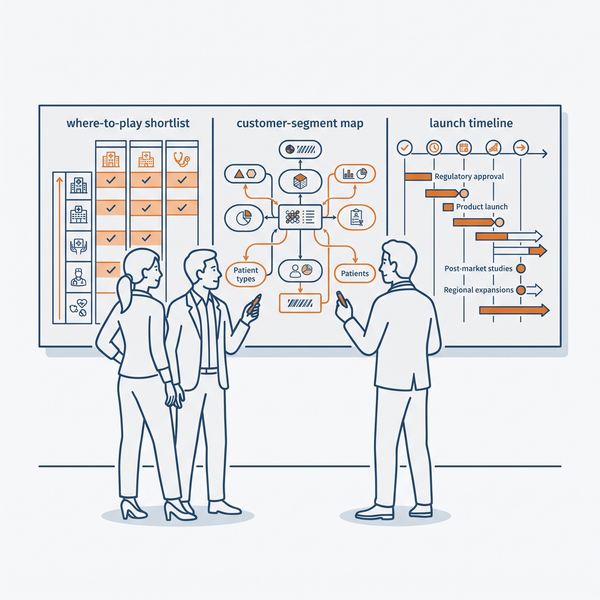
A commercial team working through a go-to-market plan
  1. 01WORKSTREAM

    Market Opportunity & Competitive Strategy

    Where to play / how to win?

    We assess:

    • Which indication offers the largest commercial opportunity?
    • Which care setting, facility type or geography has the highest adoption potential for your launch?
    • Which segment has the lowest competitive intensity?
    • What is your product’s clear differentiation — does it win on improved clinical outcomes, or on reduced length-of-stay and operational cost?

    If you’re unsure or want to validate your strategy, we can help with desk research and customer feedback to identify the right markets and the right strategy to win.

  2. 02WORKSTREAM

    Customer Ecosystem Mapping & Segmentation

    Segmentation, targeting, positioning

    We assess:

    • What are the key market segments by facility type, clinical user, or economic buyer?
    • Which segments should you target to maximize initial sales and ROI?
    • How should you position your product, device, or brand for each target segment?

    If you’re unsure which customer segments to target, we use desk research and customer feedback to identify and prioritize the most attractive segments, understand their needs, and develop the right targeting and positioning strategy to maximize sales and ROI.

  3. 03WORKSTREAM

    Market Access & Commercial Model Design (4Ps)

    What will make customers willing to adopt — and to pay?

    We assess:

    • What do customers want to hear about the benefits, outcomes and ROI your device delivers, and how it differs from the standard of care?
    • What would they be willing to pay, and how would they prefer to pay — pay-per-use, one-time upfront, value sharing, or subscription?
    • What is the ROI for the hospital, and is reimbursement available?
    • How will you sell — directly to hospitals with a sales team, or through distributors? Have those distributors been identified?
    • Which clinicians influence the purchasing decision?
    • Where and how do customers want the device promoted — peer-reviewed data, KOL advocacy, conference presentations, CME/CE education, hospital demonstrations, or direct sales engagement?

    If you want to validate your go-to-market strategy, we combine desk research and customer feedback to provide recommendations across the 4Ps:

    • Product — positioning, benefits, differentiation, and customer needs
    • Price — optimal pricing, reimbursement pathways, and payment models
    • Place — direct sales vs. distributors, including distributor identification and engagement
    • Promotion — the most effective channels and platforms to maximize impact and ROI
  4. 04WORKSTREAM

    Launch Activation & Commercial Execution (The GTM)

    Who do we target first, and how do we scale adoption?

    We assess:

    • Which hospitals, health systems, physician groups, or accounts should be targeted first to maximize early adoption and revenue?
    • Which stakeholders need to be engaged at each stage of the buying journey — clinical champion, department head, procurement, finance, IT, clinical engineering, administration, payer?
    • What is the expected customer decision-making process and sales cycle?
    • What objections are likely to arise during evaluation, procurement, and adoption, and how should they be addressed?
    • What commercial resources are required for launch — sales representatives, clinical specialists, distributors, customer support, KOLs?
    • What should the launch sequence look like across geographies, customer segments, or care settings?
    • What physician, hospital, and payer engagement activities should be prioritized during the first 6–12 months following launch?
    • What adoption metrics and KPIs should be tracked to measure commercial success?
    • How should the business scale after the initial launch phase?

    If you don’t know, or aren’t sure and want to validate, we can help with a robust, time-tested methodology driven by desk research, stakeholder interviews, and customer feedback surveys. Based on these insights, we develop a practical go-to-market execution roadmap:

    1. 01Launch readiness assessment
    2. 02Target account prioritization and sequencing
    3. 03Stakeholder engagement strategy
    4. 04KOL engagement and advocacy roadmap
    5. 05Sales force and commercial resource planning
    6. 06Customer acquisition and adoption strategy
    7. 07Sales enablement and value communication tools
    8. 08Commercial KPI framework and performance tracking
    9. 09Geographic expansion and scale-up roadmap

    The result is a practical launch plan that aligns stakeholders, accelerates adoption, reduces commercialization risk, and converts strategy into sustainable revenue growth.

Key question we answer

Where should we compete, how do we win, and how do we turn approval into adoption?

08 / 08

Hospital-level Patient-Flow Optimization

Turn clinical readiness into greater patient access and procedure growth. Having the right technology and clinical capability doesn't always translate into patient volumes — we work with hospitals and healthcare organizations to identify bottlenecks across the patient pathway, understand where patients are being lost, and develop targeted programs to improve referral, diagnosis, treatment access, and procedure volumes.

Clinicians mapping a patient care pathway

Key process include:

  1. 01

    Map the Patient Pathway

    Understand the end-to-end patient journey — from initial presentation and referral through diagnosis, treatment decision, and procedure.

  2. 02

    Identify Funnel Leakage

    Pinpoint where eligible patients are being lost or delayed, such as referral gaps, delayed diagnosis, limited awareness, capacity constraints, or fragmented care pathways.

  3. 03

    Understand the Root Causes

    Combine onsite workflow observation with interviews across relevant clinical stakeholders to understand why these bottlenecks occur and which barriers have the greatest impact.

  4. 04

    Design Targeted Interventions

    Develop practical programs to address identified gaps, which may include:

    • Physician and referral-network education
    • Patient awareness initiatives
    • Clinical training and capability building
    • Referral pathway optimization
    • Multidisciplinary coordination
    • Hospital workflow improvements
    • Identification of capacity or infrastructure gaps
  5. 05

    Measure & Optimize

    Define KPIs to monitor improvements in patient flow, referral conversion, diagnosis, treatment access, and procedure volumes, enabling continuous optimization.

Key question we answer

Where are the bottlenecks in the patient journey, and where can operational improvements create the greatest impact?

Case studies

This service in practice

Get in touch

Ready to talk about Strategy Consulting?

Tell us the decision you're facing and we'll scope an evidence-based approach.

© 2026 Sora Life Sciences. All rights reserved.